- Legal
Why Adopt Third-Party RCM Automation When Your EHR Already Has Built-In Automation?
Table of Contents
Why Do Organizations Need A Third Party RCM Automation Platform?
Organizations use third-party RCM automation when their EHR’s native revenue cycle capabilities do not offer the specialization, cross-system connectivity, depth, or financial intelligence needed to manage the entire revenue cycle efficiently.
A dedicated revenue cycle automation platform is designed specifically to manage and optimize revenue cycle workflows. It covers financial workflows from eligibility verification and charge capture through payment posting, accounts receivable, and collections activities.
For practices that:
- Struggle with denials and follow-up with providers or patients,
- Rely on lengthy, time-consuming manual contact with payers,
- Find their processes are too complex,
- Lack financial visibility or aren’t built for their specific specialty needs,
a third-party RCM automation solution can serve as a complementary layer to an existing EHR.
So rather than asking whether EHR-based RCM or a third-party solution is better, it is more meaningful to ask where our EHR’s RCM functions stop and how we can supplement this functionality with a dedicated revenue cycle automation platform.
EHR Automation Vs RCM Automation: What’s The Difference?
EHR Automation
EHR automation can include:
- Tools and workflows that reduce administrative tasks
- Tools that improve clinical documentation and charge capture
- Automated appointment scheduling and reminders
- Basic patient account balance management
- Insurance claim submission
- Basic accounts receivable (A/R) reporting
RCM Automation
- Benefits eligibility verification
- Patient account management
- Claims scrubbing
- Claims submission
- Denial follow-up and appeals
- Payment posting
- Patient statements and collections
A Key Differentiator: The “Why”?
- Why the denial occurred
- What portion of the dollar amount was denied
- Which provider and service line are involved
- Which payer is involved
- Whether the service was covered or non-covered
- Where the claim currently stands
- What action should be taken next
What are the Advantages of Using a Third-Party RCM Automation?
1. Automated EHR functionalities usually exist in a closed, single practice management system
2. Not all EHR software has the capabilities needed for specialty practices
- Managing claim submission, including global payment processes for surgical procedures with modifiers and/or secondary procedures
- Medical necessity and all associated requirements
- Associated services and procedures
- Workers’ compensation programs
- Authorization-related claim denials
- Payer-specific denials related to individual insurance providers
- Other revenue-related processes that occur after the claim has been submitted to the payer
3. Operational reporting is different from financial reporting or intelligence
How Third Party RCM Automation Can Tackle the Entire Revenue Cycle?
Patient Registration and Eligibility Verification
EHR will capture a certain amount of demographic and insurance information; but there could still be downstream problems due to inaccurate patient selection of payers, invalid coverage, duplicates, incomplete subscriber information, etc. Third-party patient access and eligibility can screen for valid coverage, benefits, coordination of benefits and patients Responsibility prior to the encounter.
It's quite simple: stop problems early rather than processing a problematic claim.
Prior Authorization
Most EHRs will capture an authorization number and a status. But this alone won’t tell them if the authorization was needed, if the correct documents were captured, was the authorization submitted, is the payer waiting on it from the portals, or is the team just letting the status be pending while it remains unsolved.
Coding & Charge Capture
Revenue is lost before a claim is even sent. Specialized coding and revenue integrity software identifies potential missed charges, inconsistent coding, missed modifiers, incomplete documentation or even specific payer requirements and will flag a potential revenue leakage problem.
Some specialties like orthopedics and podiatry require additional data analysis such as left/right laterality, global surgery rules, multiples, and medical necessity etc.
Claims & Claims Scrubbing
Converting from charge to claim generally happens in the EHR but incomplete claim information, invalid codes/combinations, mismatched attachments and specific payer coding requirements can create a denial. Third-party claim scrubbing and intelligence can apply additional edits, more robust than an EHR, along with patient payment data, historical denials patterns and other payer data.
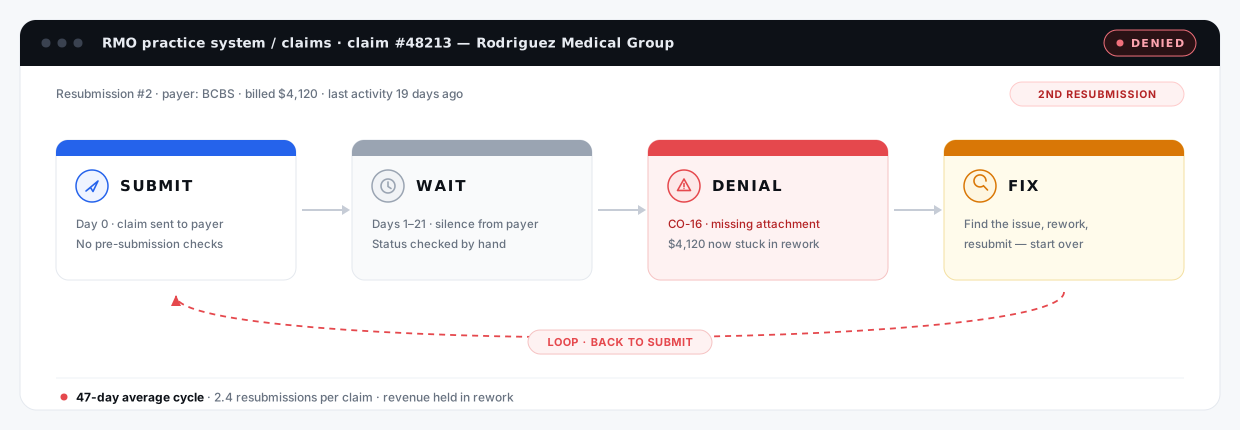
TO
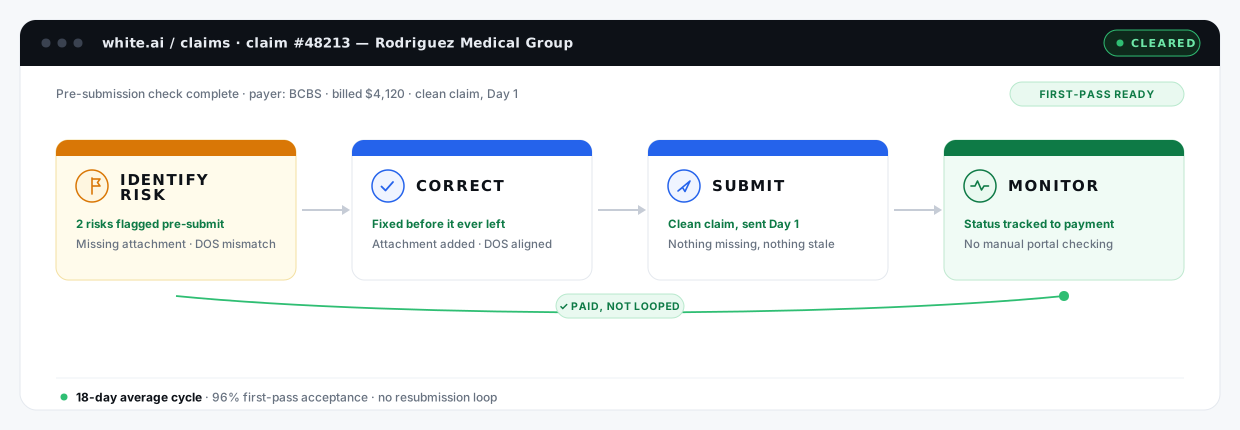
Denial Prevention and Management
Payment Posting and Underpayment Identification
A/R Follow-Up
Can Your Existing EHR Work With Third-Party RCM Automation?
For instance, eClinicalWorks lists financial integrations and connectivity through HL7 DFT and 837 claim transactions; AdvancedMD highlights open-API architecture and an RCM integration marketplace, and NextGen offers an API marketplace where users can find third-party applications. DrChrono touts its connectivity with third-party healthcare systems via its API.
- What data can the system read?
- What data can it write?
- What type of connection is it (one-way or two-way)?
- Can the platform exchange charges, claims, remittances, denials, and patient balances?
- Does it support real-time updates?
- Can it access historical data?
- How does it handle failed transactions?
- Is there an audit trail?
- Are there additional interface fees?
- Does it integrate with the practice’s clearinghouse and payer network?
- How are HIPAA, security, and business associate responsibilities handled?
How do Third-Party RCM Automation Enhance Leading EHRs?
EHRs are not without RCM functionality; their billing and RCM capabilities are substantial, and each platform enables a variety of charge-capture, claim submission, and payment processes.
eClinicalWorks:
EHR allows eligibility verifications, claims, claim status, ERA, patient statements and financial integrations, and interoperability.
Additional features the third party rcm automation tool may bring to a practice, depending on specific requirements: advanced denial analytics, payer-specific workflow prioritization, contract variance analysis, cross-platform reporting, and high-volume patient AR follow-up.
Veradigm:
Offers customizable practice-management and RCM workflows, including eligibility, referral processing, claims, follow-up queues, and outsourced revenue cycle services.
Potential added capabilities of an additional RCM tool:
Independent denial intelligence; underpayment detection; cross-payer analysis; centralized control.
AdvancedMD:
Handles medical billing, claim scrubbing, electronic claims submission, remittance processing, and financial dashboards and RCM services.
Additional benefits of a third party RCM automation may become applicable when a practice manages multiple EHRs; extensive payer workflows; requires independent comparison.
NextGen Healthcare:
It offers practice and RCM workflows; has an API marketplace for third-party solutions. Additional value of a third-party RCM automation platform may be applied beyond billing, to enhance authorization, claims denials, payer follow-up workflows, payment variance, and reporting.
DrChrono:
Supports batch eligibility verification, integrated claim management and denial insights; provides integrated ERA processing and payment reconciliation and API support.
When Should a Practice Consider Third-Party RCM Automation?
If your practice:
- Experiences recurring denials despite using EHR billing software
- Manually checks claim status through payer portals
- Experiences delays in payment posting and reconciliation
- Lacks visibility into accounts receivable (A/R) and denials
- Uses multiple systems that do not share financial data effectively
- Relies heavily on manual processes and spreadsheets
- Is planning to open additional locations
- Wants to remain committed to its EHR
How to Evaluate RCM Automation Software?
A meaningful vendor demonstration should include:
- The entire claim life cycle, from charge creation to settlement
- Eligibility exceptions and incorrect insurance coverage information
- Reject classification and root-cause reporting
- Payer-specific claim status follow-up
- ERA posting and payment reconciliation
- Underpayment and contract variability identification
- Specialty-based billing revisions
- Work queue allocation and escalation
- Audit trails and user access controls
Most importantly, compare the results against your own performance indicators.
Track the following metrics:
- Denial rate
- Clean claim rate
- Days in A/R
- A/R older than 90 days
- Post-transaction delay
- Net collection percentage
- Underpayment recovery
- Appeal overturning ratio
- Cost of collection
Your EHR Automates Billing. But Who Automates the Gaps?
Third-party software can further improve this foundation with specialized automation for:
- Eligibility checks
- Authorization checks
- Coding validation
- Claim reviews
- Denial prevention
- Denial management
- Payment monitoring
- Accounts receivable prioritization
- Patient collections
- Financial reporting