
What Is Revenue Cycle Management? A Practical Guide for Specialty Practices
Every patient visit earns your practice money.
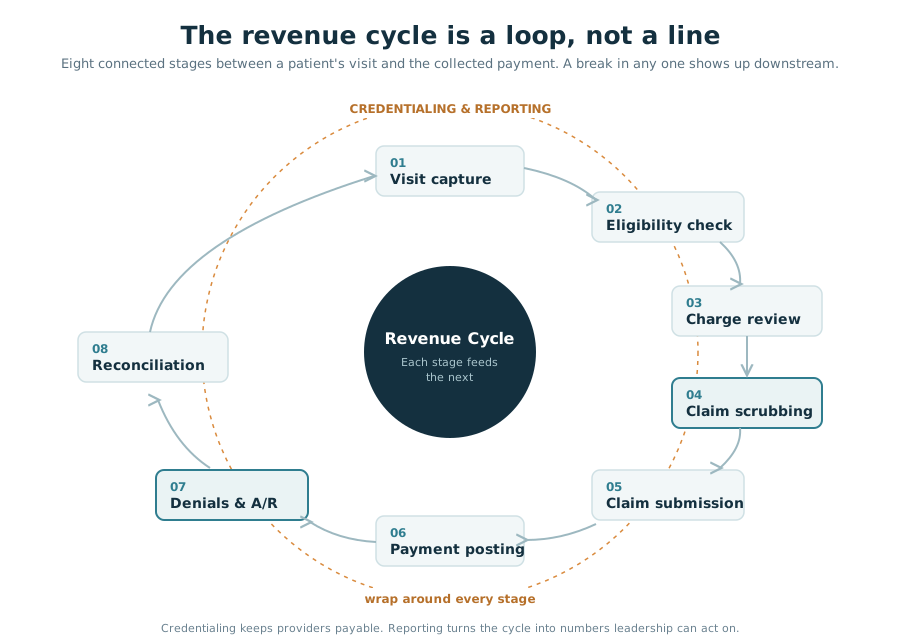
Revenue cycle management (RCM) is the financial process healthcare providers use to track a patient’s care from the first appointment to the final payment. It covers visit capture, insurance eligibility, coding, claim submission, payment posting, denial management, and reconciliation. Run as one connected cycle, it decides how much of the revenue a practice earns actually gets collected.
Table of Contents
Why it is called a cycle
“Billing is not one event that happens after the visit. It is a loop”
It starts before the patient arrives and does not close until the money is collected and matched against the bank, and each step depends on the one before it. An eligibility check skipped on Monday becomes a denied claim three weeks later. A coding gap at the visit becomes an appeal that costs a staff member an afternoon.
That is why “our billing is broken” usually means one step is broken and the damage is surfacing somewhere else, further down the line. You have to see the whole cycle to find where it actually started.
Getting paid is also getting harder. According to the Medical Group Management Association (MGMA), more than half of U.S. healthcare organizations now report denial rates above 10 percent. Kodiak Solutions put the 2024 initial denial rate at 11.81 percent, its highest in years, with accounts receivable days up more than 5 percent from the year before. The trend is clear: more claims are denied, and the money waiting behind them keeps growing.
The stages of the revenue cycle
Here is the cycle as it runs in most practices, roughly in order.
Common Causes of Denials and Lost Revenue
Trace denials back to their source and most land on a short list. Eligibility misses caught after the visit. Coding gaps that should have been flagged in charge review. Specialty coding complexity such as E and M leveling, PDPM, and risk adjustment, where the rules are dense and the denial risk is high without specific expertise. Timely filing deadlines missed because no one was tracking them.
The point is that the leak rarely happens where the pain shows up. A denial in this month’s A/R report usually started as a missed decision back at capture or eligibility. Adding staff to work denials treats the symptom. The fix is upstream, at the steps that decide whether a claim is clean before it is sent.
The RCM Challenge for Specialty Practices
A hospital runs each step with a dedicated team: someone who works only denials, a credentialing coordinator, a posting team that checks every remittance for underpayments. A six-provider pain practice has whoever is free, and that person is usually handling scheduling, coding, and follow-up in the same afternoon.
This has nothing to do with clinical quality. It is a staffing and specialization gap, and it is a big reason small practices fall behind health systems on billing benchmarks. RCM is a full-time discipline, and specialty practices carry the extra weight of coding rules that generic billing setups were never built for.
What Success Looks Like
A working system has to answer to three people at once, and they care about different things. The physician-owner wants earned revenue recovered without billing problems reaching the exam room. The practice or billing manager needs the daily controls: live claim status, automatic eligibility checks before visits, filing-deadline alerts, and one queue that shows what needs attention today. The finance lead at a multi-site group watches the aggregate numbers, days in A/R, first-pass rate, cost to collect, and needs billing and dashboards that hold up across entities. A cycle built for only one of them tends to fail the other two.
Where TrueRCM fits
Plenty of vendors will process your claims, and most will say they are faster. Speed alone does not fix a leaking cycle. TrueRCM is built around two things that do, and that most setups cannot offer together:
- The stages connect. Eligibility, scrubbing, and the A/R queue read from the same record instead of separate tools that hand off and drop things between them. A problem caught at eligibility does not come back as an appeal later.
- The specialty rules are built in. TrueRCM carries the coding logic for physiatry, pain management, behavioral health, sports and spine, geriatric and post-acute, and cardiology, the areas where E and M leveling, PDPM, and risk adjustment turn into denials when a generic platform treats every claim the same.
That is the gap a faster generic vendor leaves open. If any of the leaks above sound familiar, a 30-minute walk-through with a billing specialist who knows your specialty will show you where your workflow is losing money.
Frequently asked questions
What is revenue cycle management in simple terms?
It is the full financial process that moves a patient visit to a paid claim: capturing the visit and its codes, verifying insurance, submitting a clean claim, posting the payment, working any denials, and reconciling the deposit against the bank. Run as one connected cycle rather than separate tasks, it decides how much of the revenue you earn actually reaches your account.
What are the main steps of the revenue cycle?
The core steps are visit capture, eligibility verification, charge review, claim scrubbing, claim submission, payment and posting, denial and A/R management, and reconciliation, with credentialing and reporting running alongside. Sources count these as anywhere from seven to thirteen steps depending on how finely they split each one, but the sequence is the same.
Does adding a human review layer slow down turnaround?
Not meaningfully, when the workflow is built around it rather than bolted on afterward. AI-assisted extraction handles the volume; the human reviewer validates and flags, rather than re-reading every page from scratch.
How long does it take to get paid after a visit?
For a clean claim, payment usually arrives within a few weeks, though it varies by payer. Traditional Medicare often pays faster than Medicare Advantage, and a claim that gets denied and appealed can add weeks or months. Your first-pass clean claim rate is the biggest factor: fewer bounced claims means faster cash.
Why do so many claims get denied?
Most denials come from a few upstream causes: eligibility or registration errors, coding gaps, missing prior authorization, and missed filing deadlines. Industry data puts denial rates above 10 percent at more than half of organizations, and rising. Most are preventable, because they start at steps before submission rather than at the payer.
Should a small specialty practice outsource RCM or keep it in-house?
It depends on volume, staffing stability, and how specialized your coding is. Small practices rarely have dedicated denial, credentialing, and posting specialists the way hospitals do, which is why they tend to fall behind on benchmarks. If denials are climbing, A/R is aging, or one staff departure would disrupt billing, that is usually the signal that a specialty-built RCM partner will recover more than it costs.